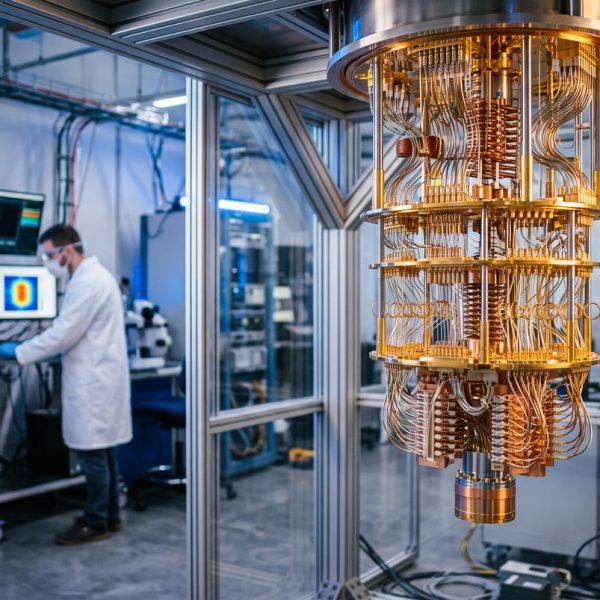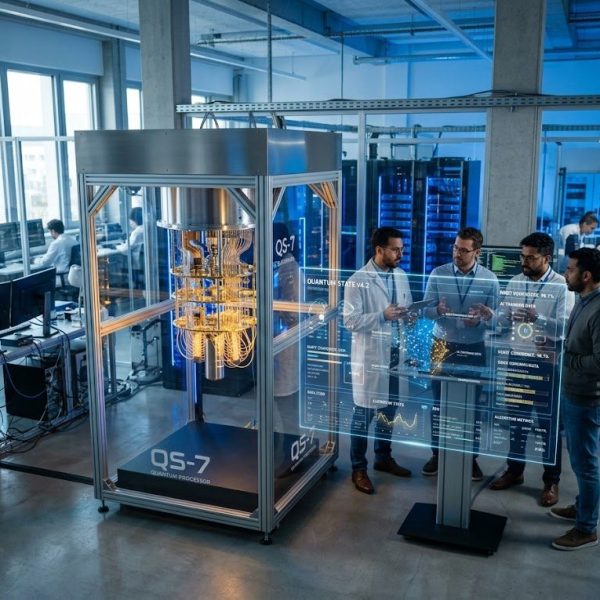

Across every industry, the rules of what computers can and can’t do are being rewritten. A new class of machines is emerging that doesn’t just run faster—it thinks differently, solving certain problems in minutes that would take today’s supercomputers longer than the age of the universe. This shift isn’t a distant sci‑fi dream anymore; real systems, real investments, and real prototypes are here right now, and they’re converging with AI, cloud computing, and automation to create an inflection point in digital transformation.
1. From Linear to Exponential Problem‑Solving Power
Classical computers work in a linear, step‑by‑step fashion. They’re powerful, but every new unit of performance usually requires more time, more hardware, and more energy. Quantum architectures, on the other hand, use quantum bits (qubits) that can represent multiple states at once. For specific categories of problems—like optimization, search, or complex simulations—this doesn’t just speed things up; it changes the entire curve of what’s computationally possible.
What was previously “computationally impossible” may soon become routine. That means breakthroughs in areas like drug discovery, climate modeling, materials science, and advanced logistics that were previously stalled by computation limits. As these capabilities move out of labs and into enterprise workflows, organizations that rely on heavy data processing will experience a sudden leap in what their analytics and operations can achieve.
2. Accelerating the Automation of Routine Business Workflows
Quantum technologies are emerging at the same time as AI, robotic process automation, and low‑code development now dominate digital strategy. This convergence matters: smarter algorithms running on new hardware will accelerate the automation of workflows across finance, HR, supply chain, and customer service.
Even before full‑scale quantum systems arrive, businesses can prepare by modernizing their digital stacks—especially around documents, billing, and compliance. Automating invoice creation with tools like a **invoice generator** is an example of future‑proofing routine operations. While quantum computing will first transform high‑complexity tasks, organizations that already streamlined basic workflows will be in the best position to plug into quantum‑enhanced services as they become commercially available.
3. Disrupting Cybersecurity and Encryption Standards
One of the most talked‑about impacts involves encryption. Many of today’s widely used cryptographic schemes could eventually be broken by sufficiently advanced quantum algorithms. That has profound implications for secure communication, banking, e‑commerce, healthcare data, and government systems.
This is not a reason to panic, but it is a reason to plan. Standards bodies and major tech companies are already working on “post‑quantum” cryptography—new algorithms designed to withstand quantum‑enabled attacks. Organizations that inventory their current cryptographic assets and adopt updated standards early will be better prepared for the transition. Those that ignore the shift risk having sensitive data harvested now and decrypted later when quantum resources mature.
4. Redefining Optimization in Logistics, Finance, and Manufacturing
Many business challenges are optimization problems: finding the best route for deliveries, the best portfolio mix, or the best way to schedule production lines. Classical computers handle these using approximations and heuristics, but the complexity grows explosively as the number of variables increases.
Quantum approaches promise to tackle these “combinatorial explosions” head‑on. Logistics providers may calculate near‑perfect delivery networks in real time. Manufacturers could optimize production to minimize waste and downtime across global facilities. Financial institutions might explore far more scenarios in risk modeling and portfolio construction. The commercial value of shaving even a few percent off fuel usage, inventory holding, or risk exposure is massive—and quantum optimization could unlock those gains much faster than expected.
5. Supercharging AI and Machine Learning
AI is already a core driver of digital transformation, but many machine learning tasks—such as training large models or analyzing vast feature spaces—are resource‑intensive. Quantum‑enhanced algorithms may dramatically speed up certain phases of model training, sampling, or pattern recognition.
In practice, that could mean more accurate predictions delivered in less time, or entirely new classes of models that are impractical on classical hardware. Industries like healthcare, finance, and retail, which rely heavily on predictive analytics, stand to benefit from faster, richer insights. As cloud providers experiment with quantum‑inspired and hybrid solutions, businesses will be able to tap into these gains through APIs without owning any specialized hardware themselves.
6. Transforming Scientific Research and Innovation Cycles
Scientific discovery often hinges on the ability to simulate complex systems. Today, modeling the behavior of molecules, materials, or climate systems at a high resolution is limited by the brute‑force demands on computing infrastructure. Quantum systems are uniquely suited for simulating quantum‑mechanical processes, which opens the door to major advances.
New pharmaceuticals, more efficient batteries, and novel materials may be designed with far greater precision and speed. This compresses innovation timelines: instead of waiting years for experimental iterations, researchers could test thousands of variations virtually in a fraction of the time. For companies in R&D‑heavy sectors, the ability to capitalize on faster discovery cycles will directly translate into competitive advantage.
7. Forcing a Rethink of IT Strategy and Talent
As quantum capabilities become more accessible via cloud platforms, organizations will be pushed to reassess their long‑term IT strategy. The question shifts from “if” to “when and where” quantum resources make sense within their existing workflows and infrastructure.
This transition requires talent and awareness. Companies that invest in educating decision makers, upskilling technical teams, and experimenting with proof‑of‑concept projects will be better positioned to identify practical use cases early. Conversely, ignoring the trend could leave businesses scrambling when quantum‑enhanced services suddenly become standard offerings in their industry.
Conclusion: Preparing Now for an Accelerating Future
The coming decade will not be defined by a single breakthrough device, but by a layered stack of technologies—AI, automation, cloud, and quantum—working together. The organizations that thrive will be those that treat this shift as a strategic transformation, not a distant research topic.
Preparing doesn’t require owning an experimental lab. It starts with modernizing digital operations, simplifying workflows, upgrading security practices, and building a culture that stays curious about emerging tools. By the time quantum‑enabled services are woven into mainstream platforms, businesses that have already streamlined and digitized their processes will be able to plug into this new power quickly and confidently.
The pace of change is accelerating, and the gap between prepared and unprepared organizations is widening. Staying ahead means acting now—adopting automation where it delivers value, monitoring post‑quantum security standards, and watching closely as quantum capabilities move from theory to practical, everyday tools.